


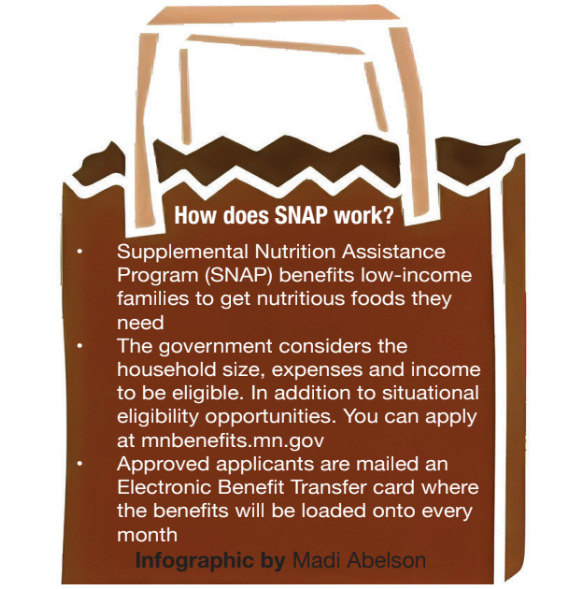
At the end of Oct. 2025, the government shutdown caused Supplemental Nutrition Assistance Program (SNAP) funding to expire, leaving many with few options for reliable access to nutrition. After a lawsuit filed by Minnesota Attorney General Keith Ellison, government funds were used to pay for SNAP benefits during the shutdown. Even after the shutdown concluded, food insecurity continues to be a prevalent issue at Park.
Junior Makenzy Altemose said her family has relied on SNAP benefits before, and the shutdown could impact families by limiting their access to food.
“(SNAP benefits) have given my family extra money for food and to help support us,” Altemose said. “(With the shutdown), people who (got) SNAP benefits wouldn’t be able to get as much food as they normally do, so they won’t have as much help.”
Sophomore Elsa Anderson said the benefits being cut could’ve taken away resources from families in need and lead to sickness, and that local resources such as St. Louis Park Emergency Program (STEP) areavailable to anyone who needs them.
“Families who need SNAP benefits (wouldn’t) have money or resources to have food, and eating is a human necessity, so it could lead to sickness, suffering and a lot of bad things,” Anderson said. “I know that STEP is in St. Louis Park and really close to the high school, and there’s resources at STEP for if you’re struggling with food insecurity.”
Park English teacher Kara Marlin said SNAP benefits ensure low-income families and young people can afford nutritious meals.
“SNAP benefits ensure that, especially young people, are getting fed, even if they are low-income,” Marlin said. “If (families) don’t have enough money to buy food and other expenses it takes to live, then they are eligible for SNAP benefits, and that allows them to buy, especially nutritious food that they might not otherwise be able to afford.”
Anderson said food is essential for a person’s survival, and that people who struggle with affording food should receive the help they need. She said our community and government should do what they can to assist community members.
“They are very helpful because so many more people than we realize need to use SNAP benefits,” Anderson said. “It (should be) a human right to be able to afford food, so if somebody’s not making the money, then our government and community should be able to support people to give them what they need to survive.”
Marlin said food insecurity and hunger can negatively impact students’ ability to learn. They said they hope to be someone that students will feel comfortable confiding in for help if they’re experiencing food insecurity, and there are resources available to students.
“When students come to school hungry, it’s a lot harder to learn, and students are often dysregulated,” Marlin said. “Students who are experiencing food insecurity sometimes come to school very tired because they’re not eating enough, and they may seek out food in other spaces. My hope would be that if I wasn’t aware and a student was experiencing that, that they would feel comfortable to tell me, and if they did tell me, I would feel confident steering them in the direction of various organizations where they could get help.”
Altemose said food shelters can be a useful resource to those experiencing food insecurity, and those who have the resources to donate do so.
“Food (shelves are a good resource) because you can go in and get food that you need, or that you can benefit from,” Altemose said. “(Those who) have extra food or extra money, (should) donate it to people or to food shelters to help people and families.”
Anderson said she’s volunteered to assist communities, and it feels very rewarding to do. She said anyone who is available and wants to help should seek out volunteering opportunities.
“I have packed food before and went on a service trip with my church, and we went to a place that served meals to people who didn’t have the means,” Anderson said. “It was rewarding to be able to help, and educational because it can be so easy to not realize how many people don’t have the things they need for daily life. Being able to help provide when I have stuff to give is a great feeling, and I think that it’s something everybody who has time, money and resources to give should do.”
Marlin said they have relied on SNAP benefits, and that those benefits can aid people in fulfilling their lives and careers. They said there are many local organizations that are simple for anyone to be a part of, and that those who benefit are appreciative of the effort to help.
“When I was in college, my partner (and I were) on SNAP (benefits),” Marlin said. “I probably wouldn’t be a teacher right now if it weren’t for SNAP. It helps a lot of people in immeasurable ways. We have the bird feeder here at the high school, (as well as) food shelves (and) food pantries open to families. There (are) individual (local) organizations focusing on helping people. It’s easier to help than people think. You can simply look up organizations in your neighborhood and reach out and say, ‘I want to be a part of this.’ It’s easy to get involved, and it feels really good because people really appreciate it, and they need the help.”


