


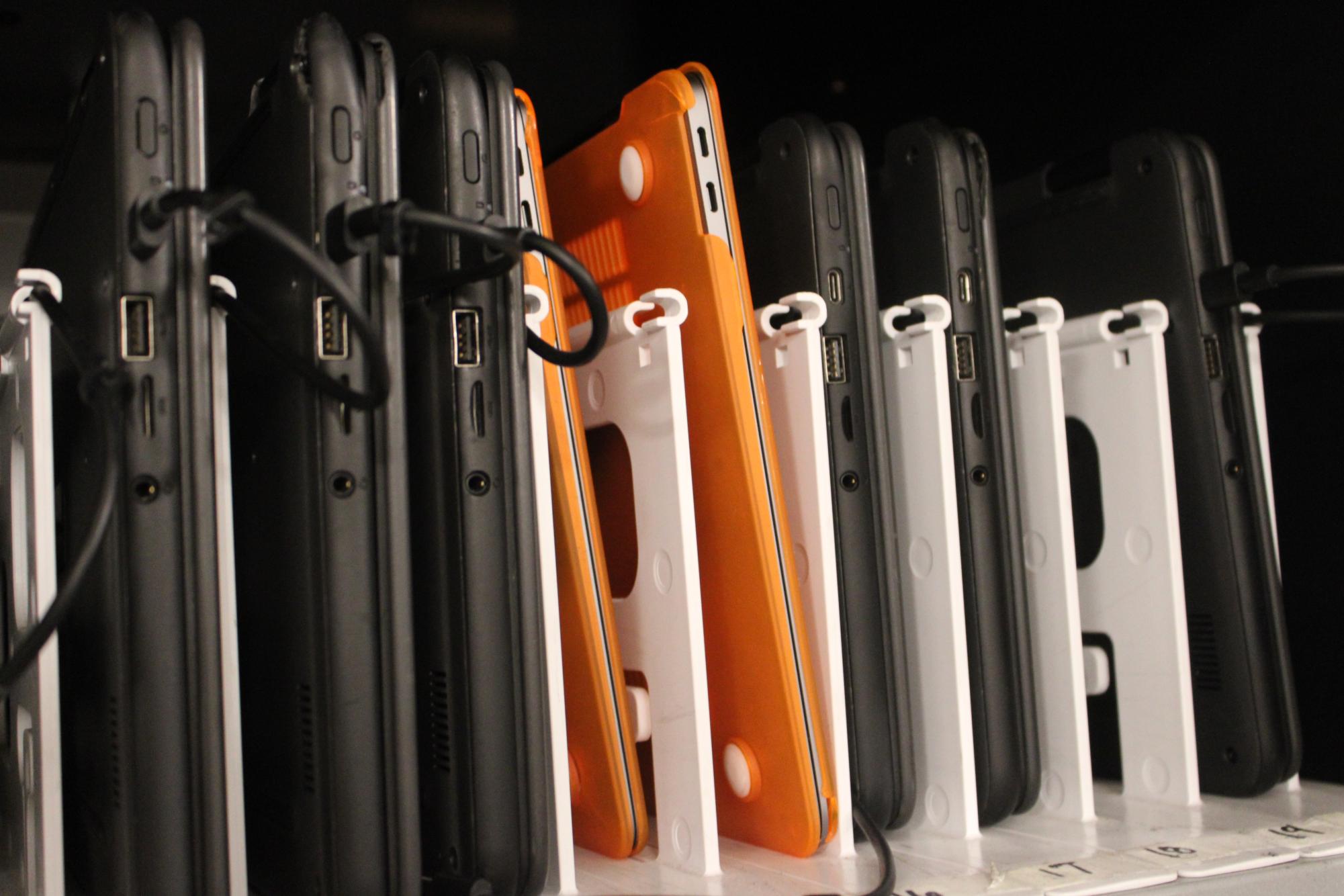
On Feb. 2, Park fully instituted a new fee on broken or lost Chromebooks and chargers. The fee states that for a new charger, a screen replacement or a broken keyboard, students now must pay $35 to the school in order to have those services done.
Park’s library media specialist, Alison Tsuchiya Theiler, said schools will always lose money on technology with their students, but Park needed a way to cut that amount down. She said public schooling doesn’t receive an infinite amount of funding, so Park’s previous role in not applying fees has ended up with the district losing funds towards their costs.
“Public education doesn’t have an endless amount of money, and so that has been something (the) Park district has implemented is not having fines and fees,” Theiler said. “But that means that you’re losing money, and no matter what, you’re going to lose money on technology with students. It’s just one of those things, but the thing is that we need to not lose as much money,”
According to business teacher Patrick Odom, he commonly sees his students with broken Chromebooks or missing chargers. He said there are examples, such as when he had a student whose space bar didn’t work properly, and how uncommon it is to see kids with their chargers during the school day.
“Every day the students will have their Chromebooks broken in some way,” Odom said. “The most egregious example was a student whose space bar didn’t work, so he had to copy the space character and just paste it in between every word. That was a particularly egregious example that I sent down for, but cracked screens, buttons not working (and) chargers gone. I feel like I can count on one hand the number of students I regularly see (that) have their chargers ready.”
Freshman Zoë Feinberg said the new fees could cause issues for those who may not be able to afford the $35. She said she also understands the cost of Chromebooks and chargers can have for the school, explaining their new fee.
“Depending on the resources and money that the people who need the replacement have, (the fee) might be problematic for them to pay, but I also know that (Chromebooks and chargers are) expensive and that the school might need money to be able to replace (Chromebooks and chargers) completely,” Feinberg said.
According to Theiler, if someone is unable to afford a new charger or Chromebook repair, she, along with the middle school media specialist, have ways to help them cover the cost. She said there is a discussion between adults in the building who can help figure out what the best cost for the student would be.
“If (a student can’t afford the fee), there is an order in place that Mr. Holmbeck and I created with our principals here at the middle and high school,” Theiler said. “Let’s just say a student can’t pay for a broken screen, so what will happen is that we’ll contact the counselors or social worker or Assistant Principle and have a conversation of, ‘hey what can we do for this student and get some information on them,’ and then if they say they can’t pay the $35 another price is determined based off of their needs.”
Feinberg said she believes the fee could be unreasonable for students who have their Chromebooks or chargers damaged by events outside of their control. She said the students who treat their technology with harmful intent deserve to pay the full amount, but others shouldn’t have to take full responsibility for damage they didn’t do.
“(The fee is) fair for the people that are purposely breaking their Chromebooks, and they should be more careful because they do cost money,” Feinberg said. “I feel like the fees in that part are fair, but also some people that have their computers broken by other people should have a discount, or maybe the person who broke the computer should (have to) pay for it.”
Odom said he finds the harm done to technology hurtful. He said the money lost from having to repair the items is careless.
“(Broken chromebooks and chargers) seems wasteful to me, I know Chromebooks are expensive,” Odom said. “Treating them in such a way where this neglect and damage upsets me at a fundamental level.”
According to Thieler, she has hopes that the fee will instill a sense of responsibility onto Park’s students. She said she wants to see less kids coming in to get their Chromebooks fixed or their chargers replaced.
“I hope it impacts (the students), that they know that they need to be responsible and take care of their devices so then it’ll last longer and they don’t have to come and get it fixed or replaced or repaired,” Thieler said.
Odom said he finds reason in the new fee because of technology’s cost and the money it takes from the district to fix and replace them. He said he wants there to be a bigger safety net for students who can’t use their Chromebook to be able to get a loaner.
“(The fee) makes sense to me, because chromebooks are expensive,” Odom said. “Obviously, we need to maintain enough funding. I’m hoping if we can increase this fee, maybe we can afford to have a backlog of loaners because I know that’s been a big factor for people, that there’s just not enough loaners to go around while they’re damaged.”
According to Feinberg, she noticed a bigger sense of obligation to keep her own technology safe. She said she doesn’t want to pay the $35, so she keeps better track of her things.
“I have more responsibility put on my shoulders to make sure I have (my charger) with me and to make sure that it doesn’t get stolen because then I would need to pay more money for (a new) one,” Feinberg said.


