
A structural shift
After researching and comparing options, Park High School is dropping the seven-period schedule for a block schedule starting next school year 2026-27. This new schedule will be four classes each quarter for a total of four quarters across the school year. Essentially, a course that would last one semester under the current schedule would now be fit into one quarter, and a student’s GPA would be updated at quarter’s end. With much uncertainty surrounding the schedule change, Echo pursued objective information to clarify its impact.
Park’s change to a block schedule is not sudden, and it’s actually been a possibility for years. According to Principal LaNisha Paddock, “Block schedule was a point of conversation before my tenure.”
A handful of different block structures were proposed as potential options. For example, an eight-over-two schedule was mentioned, meaning students would take eight classes spread over two days, switching between four classes on alternating days, and that is what Park Middle School is planning to carry out. Ultimately, at the high school level, the four-by-four schedule was selected by administration.
Created last fall, the block subcommittee comprises a teacher from almost every department, staff who support students receiving multilingual education or special education, administrative leaders, counselors and social workers. Missing from the subcommittee is student input. According to Principal Paddock, there was an aim to make a well-balanced block committee so the decisions they made could represent each student at the high school.
“You have to look at the big picture of how this (change) supports students, but you also have to narrow it down to the impact,” Principal Paddock said. “So, you have to have all those voices in the (subcommittee) space to make sure that we are addressing all the needs of each student.”
Sophomore Henry Halverson said an aspect of the seven-period day that isn’t enabling his best academic performance is the immense course load. In a four-by-four block, students would have four classes on their plate at a time.
“What doesn’t work is you have seven classes (every day), so you get seven classes’ worth of homework. I’m taking only AP and honors classes, which means that I’m gonna have a lot of homework for each class every night. That doesn’t work because I have a life outside of school, and then I also have to do every other class (work), and deadlines come real quick,” Halverson said.
Currently, Park teachers are instructing six out of seven classes, which is widely disliked by the teaching staff. In this schedule change, Park teachers who aren’t on the block subcommittee had a smaller role in decision-making. According to Assistant Principal Evelyn Lashley, there was a survey sent to all teachers allowing them to mark their opinion on scheduling. Despite a significant number of teachers choosing ‘other’ as a schedule option, those votes were not taken into account in the change.
“There was a group of teachers who presented about the block schedule as an alternative, instead of teaching six out of seven periods,” Assistant Principal Lashley said. “They presented research on why it’s
beneficial. Then that decision was made (that block is) the direction we’re going to go in. There was a form that was sent out (to teachers) between six out of seven, or block or other, and there were a lot of people who put ‘other’ (saying) five out of seven still, but that one’s not an option.”
Administration pointed out that one of the reasons the four-by-four was selected was because there are fewer passing transitions throughout the day, meaning less time for students to be in the hallway. According to the 2026-27 bell schedule, a majority of the switches between periods are five minutes in length. Students will have 80 minute blocks two times a week, and 90 minute blocks three times a week, so while class time increases, passing time does not under the block. Also a major reason the four-by-four was chosen is it allows for more instructional time throughout the school day, meaning students are spending more time in class, theoretically diving deeper into topics, than they would in a seven-period day.
According to science teacher Peter Dangerfield, “In a seven-period day, (the start and end times cause more transition time between classes). You’ll hear a lot of talk about transition time because those are ones that tend not to be as academically valuable in some classes. If you minimize those, you’re going to minimize that lost instructional time.”
Park administration looked into other school districts currently running a four-by-four, such as Wayzata, Hopkins and Eden Prairie, to get a clearer picture and prepare for how operating a block would work. In addition to longer class periods, the four-by-four model will require incoming students to take 64 credits to graduate. That is a significant, eight-credit increase compared to the previous demand of 56 credits.
Assistant Principal Lashley said conflicting emotions about the change are normal. According to her, while the shift to block is challenging, it’s driven by the trust in its value.
“I feel it too, anytime there’s going to be a big shift (it can be hard), but I also think that the payoff (of switching to a block schedule) is worth doing it, and there’s never going to be an easy time to do a big structural and methodological shift in education,” Assistant Principal Lashley said. “This system is built to keep the status quo as it has been, and so anytime you’re trying to disrupt that, it is hard, and it takes time. I get that there are mixed feelings, and that’s totally fine, but it’s deeply rooted in a belief that this is worth it.”
In the last fiscal year 2024-25, Park underwent budget cuts and changed to a six-out-of-seven schedule to reduce costs. When the numbers are crunched, running a block schedule is more expensive than the current seven-period day.
Parks Executive Director of Business Services Patricia Magnuson said the higher amount of spending is an investment in student enrichment.
“Even though we’re in tight budget times, it’s one of those times where we have to keep moving forward with the right thing to do and make sure that we keep student achievement in the forefront,” Magnuson said.
Business teacher and school store operations advisor Abby Lugo said the change to a block schedule presents students with more elective class opportunities. According to her, this adjustment might result in the school having a greater demand to hire more teachers.
“This does bode well for electives because ultimately kids will have more elective spots to fill, and so we should see the influx come into those elective spaces,” Lugo said. “Then at the same time, you have to look at (the) number of your elective teachers. Will we have a need for more elective teachers as the demand increases? That part will be interesting to unfold as we continue on this.”
The increased cost of the block schedule stems primarily from teacher salaries because the additional course offerings of the block schedule, compared to the seven-period day, necessitate a larger faculty of teachers to support it. While contracts are not completely decided, teachers will be instructing three out of four classes a semester in the new block schedule— six out of eight over the course of a year. According to the district business office, funding estimates Park High School will likely need to hire around three more teachers.
Lashley said different districts disagree on the block schedule’s efficiency for allocating funds. According to her, based on the investigation, switching to block is the best scheduling change Park could make.
“We believe, based on our research, that it is a better investment,” Lashley said. “Some other districts might not say that, but the people we talked to (said), ‘we tried to go off of (block) to save money,’ and people were like, ‘no, we have to keep it.’”
Dangerfield said the block schedule is an attempt to use Park’s budget in hopes of bringing positive change to the scholarship Park can provide students. According to him, while the block schedule was chosen with the right intentions, it is not the only piece of the puzzle when it comes to improving student performance.
“We’re trying to make (students) as best prepared as we can, and hopefully this change will succeed in that,” Dangerfield said. “But, if it was the only answer, or if it was the ultimate answer, every school would do it. If it wasn’t, no schools would do it. It can be part (of the solution to enhance education). It’s not gonna be the only thing.”
Funding the block schedule comes with potential cost reductions in other places in the Park school district. Because the school board doesn’t adopt the budget until June, the district business office is currently unable to answer what investments might be reduced. Executive Director of Business Services Magnuson said she anticipates funding increases solely for the distribution of staff in relation to the block schedule.
“The only thing it will change is this allocation of teachers, and really, we just shift our allocation of staff depending on what it is that each school needs. The allocations for supplies and other items should remain the same because we’re still teaching the same types of courses, and still (have) the same number of students. I’m not foreseeing a change in anything else, except the actual teacher numbers.”
While course content will stay the same, class structure will adapt to fill the time more adequately. Simply put, the block schedule’s longer classes will allow students to spend more time in class. Efficiency-wise, the changed schedule will allow students and teachers a chance to learn more content, quicker. For instance, a lab in science class that usually takes two class periods can be fit into one in a four-by-four schedule.
Freshman Cooper Richardson said project-based classes, such as art, will likely flow better in a block schedule. According to him, the block schedule would help minimize the impact of transition and set-up time for classes.
“(Block) could be beneficial when it comes to art electives— stuff like woodworking, pottery and construction— because it gives you more time to lock into what you’re actually doing,” Richardson said. “For example, I’m (taking) woodworking right now, and the first 10 minutes are spent getting ready, and the last 10 minutes are cleaning up. You’ll get a lot more time to actually work on your projects if you’re doing a block schedule.
When researching new schedule possibilities, Park administration found that other schools had included unique elements in their graduation requirements. As the block schedule adds a general increase of eight credit opportunities per school year, Park has looked to follow in those footsteps and add some new requirements of their own. For one, the district looks to add community service to the curriculum. Principal Paddock said, “There’s the potential to add an additional PE (physical education) credit. Most schools that are on a four-by-four block had more than one PE credit requirement for graduation.”
There hasn’t been a final decision on how year-long electives, such as Echowan and STORiole, will look at Park next year. These classes operate in ways that collect information or build experience throughout an entire school year, and could not easily be broken up into just one quarter or semester. According to Lugo, these classes might experiment with models other schools have operated with and see if it is beneficial.
“All schools run their school store program differently, but I do know that at Wayzata High School, for instance, their yearbook is a year-long class, where their managers are required to take it for that full year, and then they do have new students come in at that semester point each time.”
In the past, elective options have been cut or restricted due to the compact seven-period schedule. With the shift to the four-by-four, students will have more space in their schedules to dive deeper into new, interesting electives without impacting their core requirements. According to Dangerfield, the additional year-long class that comes with the block is a great opportunity to make school schedules more student-centered because they can take a wider variety of classes.
“We can offer more to kids (in a block schedule). In the current setup, a student can take seven (full-year) classes in a year, (but) under a block schedule, students will be able to take eight classes. That is an extra opportunity for students to get into electives that they haven’t had a chance to do, and hopefully, departments can create electives that students are interested in. I know for years we’ve tried to do some environmental science at an upper level, as opposed to just the freshman level. Here in the department, we’ve got teachers who are interested in zoology, we have teachers who are interested in anatomy, (and) we haven’t had the opportunity (to instruct them).”
In a four-by-four schedule, teachers will have fewer students at a time, allowing them to focus more attention on each individual and meet students where they are at. According to Lugo, she is looking forward to this change because she believes it will make teaching feel less stressful at times.
“Right now, I have around 180 students this semester to keep track of and to try to (get to know) because I’m not just lecture-based teaching anymore. It’s my job (to build) relationships, and get to know families and do all this stuff, but 180 is a lot. So, next year, if I have only half of that at 90, that feels a little bit more manageable.”
Block scheduling has the potential to help foster stronger relationships within the school. According to Richardson, “Being in class with people for longer does help build relationships because sometimes I can see my friends and it almost is like, ‘hi, bye,’ but in a longer (block) class, full conversations can happen.”
To achieve a positive impact on students, the staff are being trained on adaptive learning. With the block schedule comes a shift in how these classes will be taught. Because periods have nearly doubled in length, teachers will need to find ways to keep students focused and engaged. With the help of professional development, teachers are learning how to structure classes to meet the educational needs of the students. Paddock said the block schedule will keep students involved by using a variety of different teaching methods.
“This (change to block) will allow for us to plan around how it looks to engage students in different activities (and) discussions, and be more interactive, and all of that at a deeper level.”
Classes under the block schedule will be around half an hour longer than in the current day. There is a main concern that arose from this: how will students remain focused during that chunk of time? According to the American Psychological Association, humans’ attention spans are continually and rapidly decreasing. Teachers understand they will likely have to alter the way they lead their classes in order to keep students engaged and productive for longer.
The Park school district has strict rules for students to put away their cell phone devices during school hours. However, many people in 2026 are obsessed with their phones, spending a significant amount of their class time scrolling or texting. One worry of some teaching staff is that the change to block scheduling will exacerbate this issue. According to Dangerfield, “We all know cell phones are an addiction. I have that issue, kids have that issue, so how do we build up that muscle of sitting and being in a learning space for 90 straight minutes and not getting squirrely?”
According to Richardson, he is concerned about burnout and losing academic motivation in specific classes under the block schedule.
“(For) certain classes, it would be a little bit more difficult to deal with for a whole block, especially if it’s something where it requires a ton of stamina, like creative writing, for example. I’m not a great writer, and I don’t know if I’d be able to write for two straight hours. (Block) would almost discourage me a bit more with certain classes,” Richardson said.
According to Park administration, multiple strategies and instructional tools will be put into place to prevent classes where a student has to sit through 90 minutes of uninterrupted lecturing. Some four-by-four schedule supporters would argue that one of the block’s benefits is that it builds muscle for sustained focus.
Another possible downside of the block schedule is the impact it will have on Advanced Placement (AP) classes and students taking AP exams for credit in the spring. Instead of those courses stretching the entire school year, under the block, they will be fit into one semester. According to Dangerfield, he sees disadvantages of taking an AP or IB class in either semester.
“That is a worry for me. For one, having an AP or an IB class first semester and then being off for a couple months before you take the test, or two, having a second semester and having to cram all the content in before the test in May, and then it really condenses stuff,” Dangerfield said.
A possible idea to help students who take a first-semester AP is to hold review sessions throughout the second semester. Also, Park administration is scheduling AP classes based on how other districts under the block do it. Additionally, they checked in with teacher department leads to discuss what more content-heavy AP courses need in terms of class length. Still to be determined, some AP courses would be a year long in length, while others still a semester long.
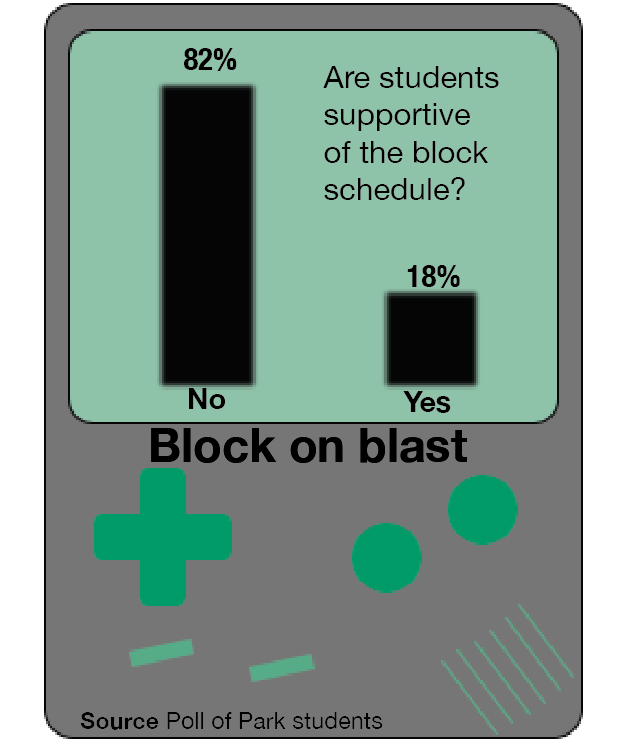
Communications to families and transparency surrounding the new block schedule were on hold until the school board finalized certain decisions regarding the change. According to Richardson, the announcements so far about the block schedule have been vague. He said the vibe around the block schedule has been somewhat negative, and people aren’t considering the upsides.
“I was on a vacation, and my parents got an email saying we’re switching (to) a block schedule next year,” Richardson said. “I haven’t seen much since. It’s just like a shadow over our heads. I haven’t seen much stuff from the school going out about how to switch to it or convincing parents. I’ve just heard people crapping on it a lot instead of hearing the benefits.”
Classes in the block schedule will progress quicker than in the current seven-period setup. Halverson said the block might make missing school more difficult.
“If you’re sick (for a day), you’re missing basically two days of a class, which would be really hard. When you have 90 minutes, you’re going to be learning more in class, so you’re going to get farther behind (if you’re not there),” Halverson said.
Furthermore, on plausible negative aspects, the block schedule will lead some students to have semester-long gaps in core subjects, and possibly cause the student to forget knowledge on the topic during the break. There is potential for a student taking a semester one science class, and then the year following, not taking another science class until semester two. Also, certain classes that benefit from long-lasting daily exposure and practice won’t be able to continue that structure under the block. For example, according to Dangerfield, math, music and world language classes are subjects that will be harder to adjust to in the block schedule.
“Math happens to be one of those because a lot of math, to me, is you learn a topic and practice it. Try to do that over 90 minutes, (and) you can’t do that anymore because that’s too much for a kid to absorb, that’s a lot of information. I think music classes should be every day. (World) language classes should be every day. So, some classes will benefit from a block schedule, and then there are some classes that I think will be (tougher in) the transition,” Dangerfield said.
According to Lugo, the block schedule will be successful for students who enter the new schedule as a freshman. However, she said the students currently in the seven-period day will struggle a little more to adjust.
“It’s gonna be great for people that start (highschool) in a block and get to finish all four years in a block. It might be a challenge for those who are caught in between and just transitioning, and it’s a lot of unknown right now, so that’s also scary about it,” Lugo said.
Park High School has never operated under a block schedule. Everyone in the school— teachers, students and staff— will need to be willing to roll with the changes. Since humans have a great ability to evolve their mindsets and adjust to new surroundings, Park can successfully transition into this block schedule. Dangerfield said in the long run, the new block schedule will not alter Park’s school culture.
“It’s something that’s new, and we’re gonna have to get used to, but I think kids are really adaptable, and whatever the schedule is going to be, you guys are going to change to it, to meet it,” Dangerfield said. “You guys all have friends who are probably on some sort of a block schedule, and I don’t think you sit around and talk about how different your school experiences are because one’s in a block and one’s on a seven-period schedule.”
Once the new four-by-four block schedule is adopted and finalized by the school board, the communication and support subcommittee, led by Assistant Principal Alonzo Parks, will be ready to help introduce the changes.
When asked what he hopes to see from the school in terms of preparing students for the schedule change, Richardson said he is looking for open communication between students and teachers, as well as easing into the change progressively.
Similar to him, Halverson said he hopes teachers are willing to receive feedback and be inclined to support student needs as they adjust to the change. “Teachers are gonna have to be extra cautious about what they’re doing in the day,” Halverson said. “If you try to cram in a lot of information, kids are probably going to be lost really fast. Teachers are going to have to, especially earlier in the class, really talk to their students and notice what they’re struggling with. If lectures (for example), get to 45 minutes and nobody’s taking notes anymore, then you probably should only do 30-minute lectures.”
According to Park administration, every school year, they create continuous improvement plan goals, and checking back in with the goals they set will help the district monitor the success of the block schedule.
Along with gathering qualitative feedback on how students and teachers are feeling about the change, looking to see if the data for number of students who need to do credit recovery has decreased and examining if retention and registration numbers in higher level courses are increasing, Assistant Principal Lashley said a good way to measure scheduling success is to focus on discipline data and seeing if those numbers have dropped.
“Data points that we would look at would be suspension and dismissal rates or discipline data, because if we’re running an effective bell schedule, we have more students in class, fewer students skipping (and) we would hopefully have fewer other discipline incidents because we would be having kids engaged in their academics,” Assistant Principal Lashley said.
According to the Park district business office, finances would not be the forefront reason to change the school schedule because the investment difference is not substantial between options. While budget constraints have been challenging, Park continues to focus on improving revenue through increasing enrollment because each student brings state and local revenue. Executive Director of Business Services Magnuson said we won’t know the lasting economic impact of the schedule early on because of presumed fluctuations, but if it thrives as research predicts, the block is here to stay at Park.
“We aren’t going to know (the block schedule’s initial financial impact) because there will be bumps in the first year, so we can’t make a decision about things. If (block) does what research says it does, it could become one of those immovable forces. If we’re running a high school, this is the schedule we’re running,” Executive Director of Business Services Magnuson said.
Principal Paddock said focusing on less at a time can lead to better results school-wide.
“It’s on the premise of less is more, or do less better,” Paddock said. “It’s okay to slow down, and not slow down in the sense that you’re going to get less content— we actually think you’ll get more from it—but you’ll have to think about less. What would it be like if you right now, at this current moment, only had to think about four classes?”
There is a lot left to figure out before the block schedule launches, and the following months will reveal how this alteration will impact different aspects of our Park community. As Park makes this change, something everyone can agree on is that they hope it is a step towards providing students with a better experience, education and preparedness for after high school graduation. According to Dangerfield, the schedule changes are only a fraction of the answer to making students want to learn. He said it’s about keeping students wanting to engage.
“That is way more important to me than a block schedule, a period schedule or whatever it is. How do we engage students? How do we engage our community, and maybe reimagine what education is and why we’re here? If you are thinking that you’re just trying to get through and the only thing you want to do is get the right answer, the computer can give you the right answer, but how do we convince (students) that it is valuable to learn? The problems we’re trying to solve, the barriers that we’re running into and the issues that we’re dealing with are beyond a schedule, and if this is part of the solution, great, but I don’t think block schedule schedule versus not block schedule is really what it’s all about,” Dangerfield said.