
Skip to Content

Securing school safety

On Aug. 27 of this year, a shooter killed two students and injured 29 people at Annunciation Catholic School in Minneapolis. As of Oct. 13, there have been over 200 instances at school when a gun is fired in the United States and 1573 since 2020. While students and staff at Park have been impacted in different ways, Park’s approach to policies in prevention and preparation remain consistent.
Signs posted on Park’s doors describe the repercussions that would follow if the front door policy is not followed Oct. 20. The signs warn that if the door is used an alarm will sound, alerting the school that someone has used the door without permission.
Emma Egan
Policies and Prevention

Principal LaNisha Paddock said because there is already such a strict gun policy, Park focuses more on general safety and prevention policies rather than guns specifically.

“The policy is there are no weapons that are allowed on campus, and that’s board policy,” Paddock said.  “Preventative measures (are) just safety overall, and that’s our top priority, making sure that there are safety and security measures school-wide”

According to Park social worker Kirsten Hanson, Park has a policy that outlaws guns outright. This policy is consistent with state law, but on the other hand, Hanson said she wants students to be able to talk to her about their concerns.

“We have a no tolerance policy (and) you cannot bring a gun to school, but what we (also) want is students to feel connections with teachers and staff so that if they hear of something (or) see something, they’ll come and talk to us, and we can deal with that,” Hanson said. 

Junior Amelia Ray said she does not feel more or less safe in the building, but she wants to be on alert in case something, such as a shooting, were to happen.

“I have to be more aware of my surroundings at school, but I don’t know if I would say I feel less safe, at least in our building,” Ray said. “I think that the school does a really good job at keeping us safe, but I feel a need to watch out more, and I should always be ready in case something were to happen.”

Hanson said there is a system set up for a potential active shooter and steps that teachers and staff would follow. Hanson said these steps include locking doors, taking cell phones, keeping students away from windows and keeping students calm.

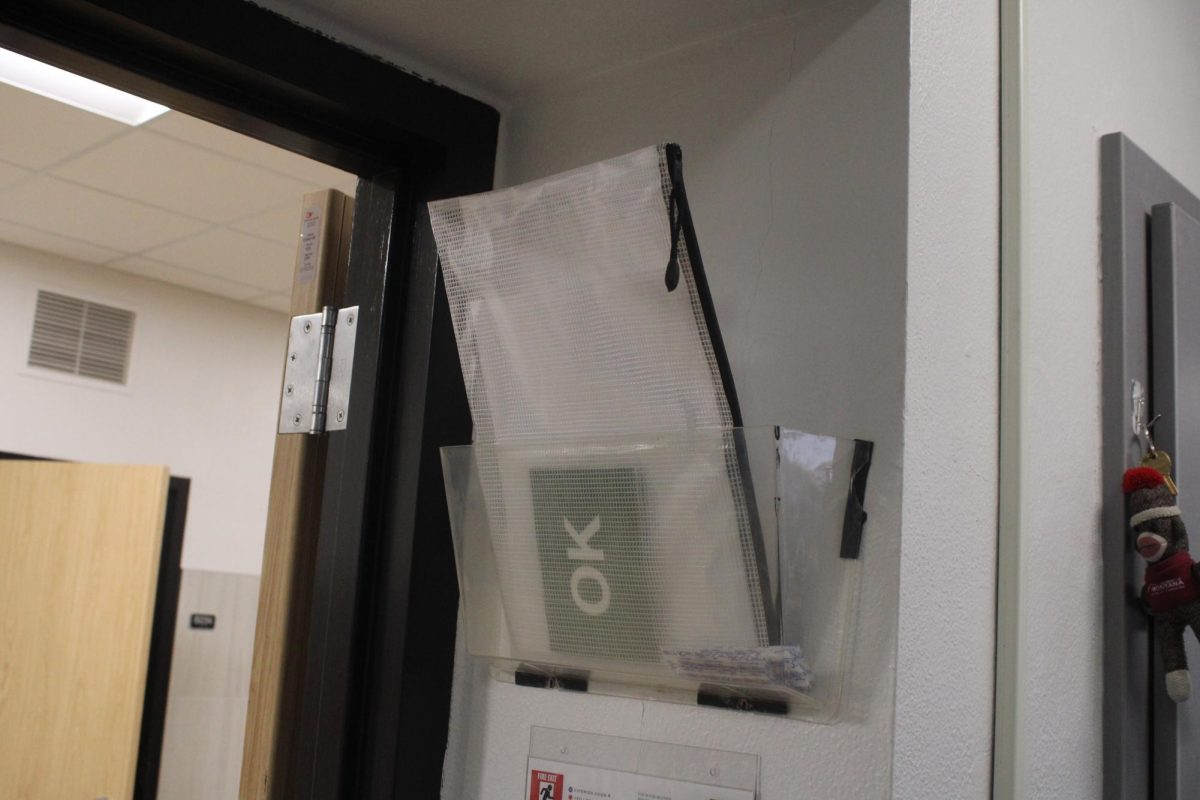
“In the case of an active shooter, that would be where we’d go into a lockdown,” Hanson said. “We would secure all the doors. There’s a magnet that we use so that the doors are always remaining locked, so that somebody doesn’t have to go into the hallway, especially if there’s a shooting going on at the time. We just pull those magnet doors locked, and then we try to gather students’ cell phones, move them away from windows, move them away from doors and just keep everybody quiet and calm.”

According to Park social studies teacher Charlie Mahaffey, many people have spoken up about gun violence, but no real change has been made. Mahaffey said he wants to see more education around gun violence for students to address the problem as a whole.

“You see thousands of people gathering and saying ‘this can’t happen’ and ‘this is awful,’ but then nothing changes, and it’s that over and over again,” Mahaffey said. “If we don’t talk about that, then we can’t ever address it. It doesn’t seem like there’s an amount of sorry that will magically solve the problem. We have to talk about the actual problem and educate students on how we could live in a different world.”

Ray said lawmakers aren’t on the same page as local authorities and there needs to be more preparation for handling situations of gun violence. She said people have been desensitized to gun violence and are not acknowledging those affected.

“I think a lot of people making legislation don’t understand what’s really going on, and a lot of times, they don’t understand the local authority’s way of doing things,” Ray said. “I think local authorities need to be trained better to be able to handle it, and I think that the laws should reflect the best interests of the students and everyone actually in the building. I think people have gotten desensitized to it because it happens so often, and I think that we should be more caring about the families being affected by gun violence.”

According to Hanson, future policy changes should include a ban on automatic weapons and on bump stocks. She said the Second Amendment is outdated, given that the country is not being attacked.

“I don’t see any reason why we would ever need automatic weapons in the hands of a regular person,” Hanson said. “Under no circumstances should there be that. I don’t know why we would have bump stocks, something that would make it so that (a gun) can automatically repeat. I don’t know why we need to have these weapons. The Second Amendment was put in place when we were under attack from the British. We are not under attack from the British. There are weapons that we have in people’s hands that there’s absolutely no reason for.” 

Junior Hannah Levitt said she supports legislation banning assault rifles, limiting possession of ammo and who can register for a weapon. She said these changes could help stop school shootings.

First and foremost, I’d like to see an assault rifle ban,” Levitt said. “It worked in the past, and should work again. (I want) checks and balances for people registering for weapons, and separate legislation on how much ammo a person can have in their house at once. I think that would also help (prevent) school shootings.”

According to Hanson, in the event of a shooting at Park, it would be her and other counselors’ responsibility to make a plan and help students. She said the plan would have to accommodate students who wanted to come back after a shooting and those who would not. She said the counselors and social workers would need to meet kids where they were at and make individualized plans.

“Us social workers, counselors, would be available for students (in the event of a shooting),” Hanson said. “We’d also be pulled in to develop the plan. How are we going to support families? And then what would a re-entry back look like? What is the time that we feel like is needed? Because there’s going to be this huge spectrum. Some students are going to be like, ‘I want to be back in school the next day because I need that routine.’ Other students are going to be like, ‘I’m never walking through those doors again.’ We saw that with annunciation. How do we account for all of those different needs while the student who’s like ‘I can’t come back through those doors’ isn’t being punished, and the student who can has somebody that they can meet with.”

Park’s response to Annunciation

According to Paddock, in the aftermath of the Annunciation shooting, the Park administration team met and discussed how to make sure Park schools were safe, and concerns of families were addressed.

“The first thing when you have something that happens out in the community is acknowledging the emotion around it and how personalized it is,” Paddock said. “People knew families that were impacted by that tragic event. I think the next thing was making sure that we had a meeting afterwards with our Park leads department, and we process safety and security here (at Park). Are there any gaps in our safety and security?”

Levitt said she is concerned by how often guns and shootings are discussed and how accustomed she has become to the conversations about shootings.

“We’ve had (school shootings) at such a regular pace that they’ve become kind of a casual conversation to a point where it doesn’t affect me as much as I want it to affect me, just because it’s become so normalized,” Levitt said.

Sophomore Anjali Narais said she wanted more conversations to be had about recent school shootings at Park between students, staff and administration. According to her, being in close geographical proximity to the Annunciation shooting, students should have had more opportunities to share their feelings.

“Allowing us to grieve, and allowing us to have our voices be heard is important,” Narais said. “(Park) could have done more when we came back to school following the Minneapolis shooting, especially being so close (to the shooting), allowing us to share our emotions. I think that should be addressed more school-wide.”

According to Ray, students and families affected by gun violence, particularly by Annunciation in Minnesota, should be influential to lawmakers.

“The students who have been directly affected by gun violence and their families are the ones who have the strongest voices in this, and should be heard by people making laws,” Ray said.

According to Assistant Principal Alonzo Parks, most families at Park have not expressed concerns about safety surrounding gun violence. Parks said the feedback the administration has heard is that the school feels very safe.

“The feedback we’ve gotten so far, it’s quite the opposite. Students are feeling really safe in the building this year and things feel really calm so we’ve gotten the opposite feedback around the tension. But again, that may exist just that we haven’t heard that feedback”

Mahaffey said conversations about school shootings are difficult for students to have because of the emotional complexity. He said these feelings students have carry over into their behavior at school.

“When mass shootings happen, there’s a lot of fear for students that they’re not always super comfortable naming, because I think they don’t know how to have conversations about it,” Mahaffey said. “It feels like an issue that’s so hard to solve, that you’re better off just not thinking about it, (not) talking about it and it’s hard. I think it definitely shapes how students show up in class.”

Hanson said she does not want students to feel unsafe at school. According to her, schools are the safest place for a student to be, given the unlikelyhood of a shooting actually happening at Park.

“In no way, shape or form should students be unsafe with gun violence here at school,” Hanson said. “But my perspective is I’ve been doing this for 29 years, and I’ve never had to deal with this. There are a lot of schools across the country every single day where students are very, very safe. It really is the safest place for students to be.”

Narais said the victims of gun violence and their families should be heard and valued. Narais said she wants more focus on gun violence by leaders and a reconsideration of the necessity of the Second Amendment.

“Addressing the victims and the families who’ve lost their children to gun violence is so important, because those people aren’t going anywhere,” Narais said. “I feel like so many funds and energy are going into other things that are not as vital, and addressing those lives lost is a first step I want to see. I don’t think our Second Amendment rights should be prioritized over the lives of others.”

According to Mahaffey, he understands why rights are important to protect, but some are more crucial and significant than the possession of a gun.

“Part of me understands people feeling protective of their rights,” Mahaffey said. “It’s just kind of ironic, especially in the current moment, to watch people absolutely lose access to many civil rights, and then the one we’re left with is a gun.”
Personal Experiences

According to Narais, she worries about gun violence at Park, not just at the high school, but in the elementary schools as well, because of her family connections.

I fear for myself and my friends at school, along with a younger brother who(m) I feel so scared for,” Narais said. “I go with him to drop him off at elementary school every morning, and I feel very scared dropping him off there and leaving him. I don’t think that should be a feeling anyone should have to feel.”

Parks said having a child in the district relates to parents concerned about safety. He said ensuring the safety of students is a top priority for the administration team.

“For me, it’s very personal, because I have an eight year-old at PSI in the district. I (know) kids (in the Park kids place program), so it’s, I know that all parents are concerned about school (safety), right? And it’s our job to make sure we keep everyone safe.”

According to Hanson, she has a daughter who worries about her working in a school because of the potential of a shooting. She said she is not concerned with her own safety in the school. 

“I have a daughter who’s 20 years old, and she hates that I work in school because of (gun violence),” Hanson said. “The way that I’ve always talked with her about it and with students is ‘I want you to think about the big picture, there are literally hundreds of thousands of students who are in school every single day, and they are safe’.”

Levitt said she went to a gun violence protest with her mom. She said this experience and hearing from different people with different perspectives shares their experiences with gun violence inspired her to become more politically active.

“My mom took me to a March for Our Lives protest in 2016,” Levitt said. “My mom was a teacher, and she knew one of her former students was speaking. We went there, and we listened and there were people marching and talking from all different walks of life, teachers, students, activists and just regular people. It felt really empowering, and it’s one of the reasons that I became interested in politics.”

According to Narais, she has participated in protests against gun violence and tries to share information about them with other young people on social media.

“I participated in the march at the (State) Capitol following the Annunciation church shooting, and before that, I participated in the No Kings Day protests, where gun violence was a prominent topic that we talked about there,” Narais said. “I try to get information out to others via social media, along with talking about these issues in my everyday life.”

Ray said guns are ingrained in society to a point where they cannot be banned. She said guns can cause problems, but they can also be necessary in some situations.

“I feel that inherently guns do have a purpose in society, and if we banned them outright, there might be problems,” Ray said. “I think that they are a tool for escalated violence, but also escalate violent situations at the same time.”

Mahaffey said he grew up in an area where owning a gun was common, and he himself had used a gun for hunting purposes.

“I probably grew up shooting guns more than almost any teacher in the building, because I grew up in a really rural place and I hunted,” Mahaffey said. “I shot a fake pop gun when we would go hunting until I was old enough to get my hunting license. I shot shotguns and rifles. I was gifted an AR-15 when I was a teenager.”

According to Levitt, youth can have an impact on gun changes and legislation despite not being at voting age. She said they can talk to lawmakers, protest and inform adults, and should do so, given that gun violence affects youth.

“I do believe that young people can have a really big influence, even though we can’t vote,” Levitt said. “We still have the right to assemble and to make changes and to ask our policy makers and help inform our parents. (Gun violence) is becoming such an issue for youth specifically, (and) we can always do more change.”

More to Discover